
Executive Due Diligence in HSE: What Good Governance Looks Like in Practice

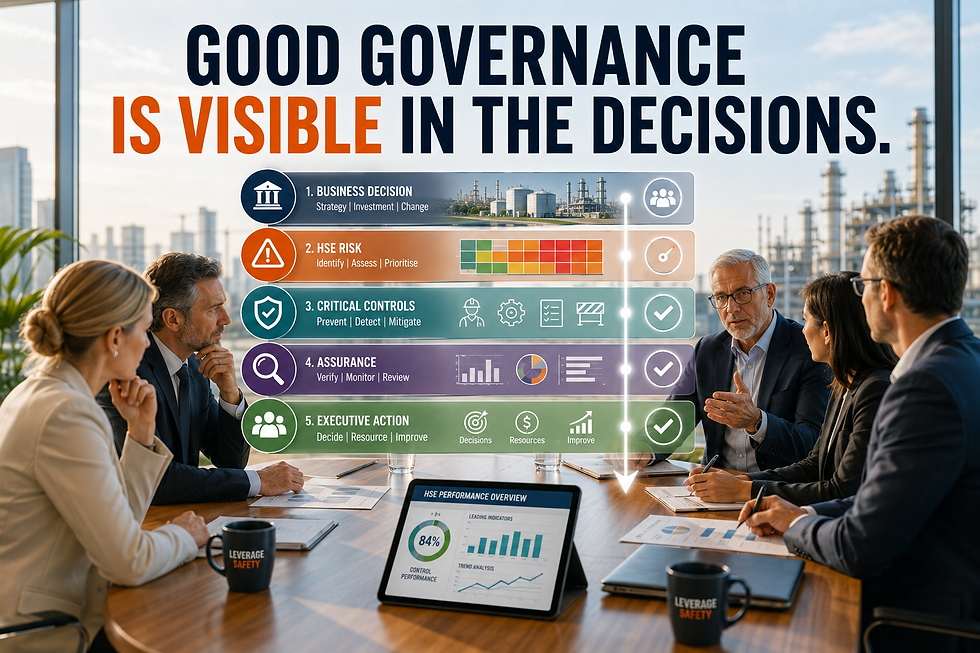
Most senior leaders will say that health and safety matters.
Fewer could clearly explain what effective HSE governance actually looks like in practice.
That distinction matters.
Good governance is not a signed policy, an annual board presentation or a handful of site visits. It is the system by which leaders ensure that significant HSE risks are understood, responsibilities are clear, resources are adequate, controls are effective and the organisation is learning before failure forces it to.
In other words, governance is about evidence.
Can the board demonstrate that it understands the organisation's most significant HSE risks? Can senior leaders explain what controls they rely on to prevent serious harm? Do they know where vulnerabilities are increasing? Are they receiving information that helps them make decisions rather than merely reporting activity?
If the answer to those questions is unclear, then leadership commitment may exist in principle without being fully translated into governance.
That is where due diligence becomes important.
Due Diligence Is More Than Being Informed
Senior leaders often receive large amounts of HSE information.
Injury rates, audit results, training compliance, overdue actions, contractor statistics, environmental data and incident summaries all make their way into executive reports.
That information is useful.
But being informed is not the same as exercising due diligence.
Due diligence requires leaders to do something with the information.
They need to understand it, challenge it, identify where uncertainty exists, and make decisions proportionate to the risk.
A board that receives a monthly HSE dashboard but never tests the assumptions behind it may be well-informed and still poorly governed.
The key question is not, “Did the board receive the report?”
It is, “Did the board understand what mattered and act where necessary?”
That is a much higher standard.
Governance Starts With Understanding Material Risk
Executives do not need to know every hazard in the organisation.
They do need to understand the significant ones.
What could kill people?
What could create multiple serious injuries?
What could result in major environmental harm?
What could materially disrupt the business or damage its licence to operate?
Good governance begins with clarity around those exposures.
This is where risk profiling becomes important.
HSE's HSG65 guidance explicitly frames health and safety as part of good management and places risk profiling, planning, implementation, performance measurement and review within a wider Plan, Do, Check, Act approach. citeturn451630search9
That matters because boards should not be reviewing HSE in isolation from business strategy.
If the company is expanding into a new market, changing contractor strategy, restructuring, reducing headcount, accelerating a project or acquiring a new asset, HSE exposure may change with it.
Governance therefore needs to follow the business.
Boards Should Know What They Are Relying On
Understanding the risk is only the first step.
The next question is more important:
What are we relying on to control it?
For significant hazards, leaders should know the critical controls or safeguards that stand between the organisation and a serious event.
This does not mean board members need to become engineers or HSE specialists.
It means they should have enough understanding to ask intelligent questions.
What prevents loss of containment?
What protects people working at height?
How are lifting risks controlled?
How do we know travel risks are being managed?
What prevents an organisational change from eroding competence?
What happens if a critical control fails?
This kind of questioning shifts HSE governance away from generic performance reporting and toward control effectiveness.
In high-hazard industries, that distinction is especially important.
Low injury rates do not prove that major accident risks are well controlled.
Leaders need visibility of barrier health, critical control performance and operational vulnerability.
Governance Needs the Right Information
One of the biggest weaknesses in executive HSE oversight is information quality.
Boards often receive what is easiest to measure rather than what is most useful to know.
Training completion.
Audit percentages.
Incident rates.
Inspection counts.
Action closure.
All of these can be valid indicators.
But none automatically tells leaders whether material risk is well controlled.
The Energy Institute's guidance on safety decision-making at leadership level highlights exactly this issue: leaders need good-quality information, appropriate understanding of risk and awareness of the factors that influence decision-making.
The implication is clear.
Executive HSE reporting should help leaders decide.
Where is exposure increasing?
Which controls are weakening?
What uncertainty exists?
Where are actions recurring?
What requires investment?
Which decisions could materially alter the risk profile?
A dashboard that cannot support those conversations is not really a governance tool.
It is a reporting tool.
Ask Whether the Information Could Be Wrong
Good governance requires healthy scepticism.
Not cynicism.
Scepticism.
A board should occasionally challenge whether the information it receives is complete, timely and representative.
If every indicator is green, are we genuinely performing well?
If there are no significant concerns, is bad news reaching leadership?
If contractor performance looks excellent, how much assurance do we have below the principal contractor level?
If training compliance is 100 per cent, how do we know people are competent?
If audit findings are declining, does that reflect stronger control or weaker challenge?
Executives should not assume that management information is false.
They should recognise that all information systems have blind spots.
The goal is to understand where those blind spots might be.
Due Diligence Requires Visible Challenge
Boards and executives need to demonstrate that HSE is not a passive agenda item.
Challenge matters.
Not because leaders should second-guess every technical decision, but because significant risk deserves scrutiny.
What evidence supports the conclusion?
What alternatives were considered?
What assumptions are we making?
What happens if the control fails?
What are we not seeing?
These are governance questions.
They are especially important when decisions involve cost, schedule or organisational change.
It is easy to demonstrate leadership commitment when there is no conflict.
Governance becomes real when commercial or operational priorities create pressure.
If a project is behind schedule, will leadership accept increased exposure to recover time?
If maintenance costs rise, will critical work be deferred?
If headcount is reduced, will safety-critical responsibilities still be adequately covered?
These are not HSE department decisions.
They are executive decisions with HSE consequences.
HSE Responsibilities Must Be Clear
Good governance depends on clear accountability.
Who owns the risk?
Who maintains the control?
Who verifies performance?
Who escalates failure?
Who has authority to stop work?
Who reports significant concerns to leadership?
These responsibilities should be understood across the organisation.
HSE itself should not become the default owner of all safety-related risk.
Operational leaders remain accountable for the activities they control.
HSE should advise, challenge, facilitate and assure.
That distinction is important because governance weakens when responsibility becomes ambiguous.
If everyone assumes HSE owns safety, nobody else fully owns it.
Resources Are a Governance Decision
Safety performance is influenced heavily by resources.
Competent people.
Time.
Maintenance.
Engineering support.
Technology.
Training.
Supervision.
Emergency capability.
If leaders expect strong HSE performance but do not provide the capacity required to deliver it, the system becomes dependent on people compensating for resource gaps.
Good governance therefore needs to examine whether resources are proportionate to risk.
This does not mean approving every request made in the name of safety.
It means making deliberate decisions.
If resources are constrained, leaders should understand what controls may weaken as a result.
That is due diligence.
The risk does not disappear because the budget is difficult.
Contractor Risk Still Belongs on the Governance Agenda
Outsourcing work does not outsource the consequences.
Where contractors perform significant or high-risk work, governance arrangements should extend into the contracting model.
How are contractors selected?
How is capability verified?
What happens during mobilisation?
How are subcontractors controlled?
How is performance monitored?
When does poor HSE performance affect commercial decisions?
These are governance questions because they influence the organisation's exposure.
A board that receives only internal employee injury statistics may therefore have an incomplete view of HSE risk.
Where the risk sits in the value chain matters less than whether the organisation understands and manages it.
Organisational Change Needs Executive HSE Oversight
Significant organisational change is one of the clearest examples of HSE governance extending beyond the HSE function.
Restructuring.
Acquisitions.
Downsizing.
New operating models.
Outsourcing.
Digital transformation.
Leadership changes.
All can affect competence, workload, communication and accountability.
Executive due diligence should therefore ask how these changes affect the conditions needed for safe work.
Does the new structure retain enough technical capability?
Are spans of control increasing?
Are safety-critical roles changing?
Will workload rise?
Are responsibilities becoming unclear?
This is where governance needs to be proactive.
Waiting for HSE performance to deteriorate after the change is too late.
Board Site Visits Should Inform Governance
Site visits can be valuable for board members and executives.
But the objective should not be inspection.
It should be understanding.
Leaders should use site visits to test whether management information reflects reality.
Can workers explain the major risks?
Are critical controls visible and understood?
Do supervisors appear overloaded?
Are people comfortable raising concerns?
Does the work look consistent with the governance picture presented at board level?
This creates a useful connection between strategic oversight and operational reality.
It also helps leaders avoid relying exclusively on filtered information.
The UK HSE's leadership guidance specifically emphasises active leadership, worker involvement and effective monitoring and review by directors and boards.
The purpose is not to turn board members into auditors.
It is to help them understand the organisation they are governing.
Psychological Safety Is a Governance Issue
This may not be obvious at first.
But it matters.
Boards depend on the organisation to surface bad news.
If employees, contractors or managers do not feel able to escalate concerns, governance becomes blind.
A strong reporting culture therefore supports due diligence.
Do people speak up early?
Can HSE professionals challenge senior leaders?
Can contractors raise concerns that might affect schedule or cost?
Are near misses reported?
Does management respond constructively when uncomfortable information appears?
These behaviours determine the quality of the information reaching leadership.
Governance depends on candour.
Audit Is Not the Same as Assurance
Boards often rely heavily on audit results.
Audits are important.
But audit and assurance are not interchangeable.
Audit tells you whether selected requirements are being met.
Assurance asks whether the organisation can be confident that the overall system is functioning effectively.
That may involve audit, critical control verification, technical reviews, field observation, incident analysis, workforce feedback and performance trends.
A good governance system uses multiple sources.
This creates triangulation.
If the dashboard is green but workforce feedback suggests significant strain, investigate.
If audit results are strong but critical controls are repeatedly degraded, investigate.
If incidents are low but maintenance backlog is rising, investigate.
No single data source should dominate the picture.
Management Review Should Be More Than an Annual Ritual
Management review is often treated as a formal requirement.
A meeting is scheduled.
Inputs are presented.
Outputs are recorded.
The requirement is satisfied.
But management review should be one of the strongest governance mechanisms in the system.
It should answer whether the HSE management system remains suitable, adequate and effective.
That means leadership should examine changes in context, performance, resources, risk, controls and organisational capability.
ISO 45001 places leadership, governance, worker participation and continual improvement at the heart of the OH&S management framework.
A management review that simply confirms that all agenda items were covered misses the point.
The purpose is to test whether the system still works.
Executives Should Be Able to Demonstrate Their Decisions
Due diligence is easier to defend when decisions are deliberate and traceable.
Why was a particular risk accepted?
Why was investment approved or deferred?
What information was considered?
What alternatives were reviewed?
What additional controls were required?
This does not mean creating bureaucracy around every decision.
It means ensuring significant HSE-related decisions are made consciously rather than by default.
A documented rationale also supports organisational learning.
Future leaders can understand why a decision was made and what assumptions supported it.
Good Governance Is Continuous
HSE governance should not be something that happens once a quarter.
Risk changes continuously.
Operations change.
People change.
Contractors change.
Projects move into new phases.
Economic pressure changes.
Governance therefore needs a rhythm.
Regular executive review.
Clear escalation triggers.
Periodic deep dives into material risk.
Management review.
Field engagement.
Independent assurance.
These mechanisms should reinforce one another.
The objective is not more meetings.
It is better visibility.
The Test of Good HSE Governance
A useful test is to imagine the board is asked several straightforward questions.
What are the organisation's most significant HSE risks?
What controls prevent the worst outcomes?
How do you know those controls are working?
Where is the organisation becoming more vulnerable?
What HSE issues currently require executive action?
How do workers and contractors raise concerns?
What recent decision materially changed the risk profile?
What assurance tells you the HSE management system is effective?
If leaders can answer those questions clearly and with evidence, governance is probably functioning well.
If the answers rely mostly on injury rates, policies and audit completion, there may be a gap.
Governance Is What Leaders Do With Risk
Good HSE governance is not complicated in principle.
Understand the risk.
Know what controls it.
Make responsibilities clear.
Provide the resources needed.
Demand useful information.
Challenge assumptions.
Listen to the organisation.
Intervene when controls weaken.
Review whether the system remains effective.
None of these activities belongs exclusively to the HSE function.
They are leadership responsibilities.
HSE specialists can provide the framework, expertise and assurance.
But governance sits with those who make the decisions that shape the organisation.
That is the real test of executive due diligence.
Not whether leaders say safety matters.
Not whether the policy is signed.
Not whether the dashboard is green.
The test is whether leadership decisions consistently demonstrate that significant HSE
risks are understood, governed and acted upon.
That is what turns commitment into accountability.
And that is what good governance looks like in practice.
References and Further Reading
UK Health and Safety Executive (HSE). Leading Health and Safety at Work (INDG417). Guidance for directors, governors, trustees and board members on leadership actions, worker involvement and effective monitoring and review. citeturn451630search0
UK Health and Safety Executive (HSE). Managing for Health and Safety (HSG65). Guidance on integrating health and safety into good management through risk profiling, planning, delivery, monitoring and review. citeturn451630search9
UK Health and Safety Executive (HSE). Legislation on Leading Health and Safety. Guidance on collective board responsibility and ensuring health and safety is considered in board-level decision-making. citeturn451630search31
International Organization for Standardization (ISO). ISO 45001:2018 – Occupational Health and Safety Management Systems. Requirements addressing leadership commitment, governance, worker participation, risk management, performance evaluation and continual improvement. citeturn451630search2turn451630search24
International Association of Oil & Gas Producers (IOGP). Operating Management System Framework. Framework identifying leadership, risk management, implementation and continuous improvement as fundamentals of an effective operating management system. citeturn451630search3
Energy Institute. Supporting Safety Decision Making in Companies: Briefing Notes for Board Members, Managers and Other Leaders. Guidance on improving risk understanding, information flow and the quality of leadership decisions affecting major accident hazard safety. citeturn451630search7

