
Stop Doing Safety Walks. Start Having Better Safety Conversations.

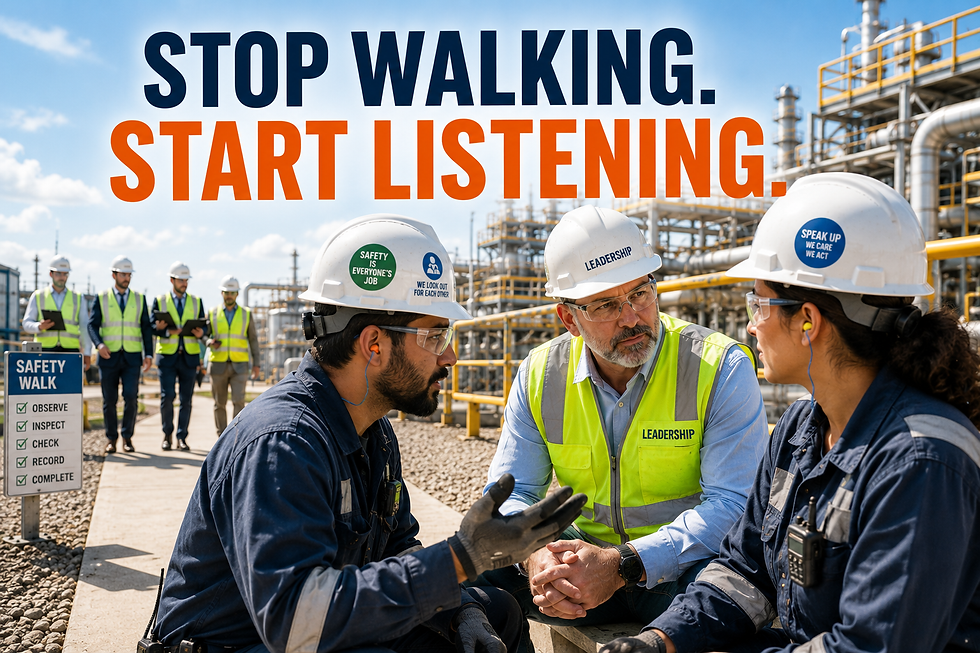
Many organisations measure leadership commitment to safety by counting visits.
Senior managers are expected to complete a certain number of safety walks each month. Executives visit projects. Department managers tour facilities. Supervisors conduct observations. The numbers are recorded, entered into dashboards and reported as evidence of visible safety leadership.
The intention is good.
Leaders should spend time where work actually happens.
But there is an important distinction between being visible and being useful.
A manager can spend an hour walking around a workplace without learning anything meaningful about how risk is being managed. They can inspect housekeeping, identify missing gloves, ask whether everything is safe and return to the office convinced that leadership engagement has occurred.
Technically, it has.
The question is whether anything valuable happened.
The strongest leadership visits are not inspections disguised as conversations. They are opportunities to understand how work is actually being performed, what is making it difficult, where controls are vulnerable and what the organisation can do to help people succeed.
That requires a different kind of conversation.
The Safety Walk Has Become an Institution
Leadership safety walks exist for good reasons.
They increase management visibility. They provide opportunities for direct engagement with employees. They allow leaders to see conditions personally rather than relying entirely on reports and dashboards.
Used well, they are extremely valuable.
The problem begins when the activity becomes the objective.
The organisation establishes a target: every senior manager must conduct two safety walks each month.
Immediately, something subtle changes.
The question moves from:
“What are our leaders learning from the workplace?”
to:
“Have our leaders completed their safety walks?”
The metric becomes completion.
Managers become busy. The end of the month approaches. Visits are scheduled because the dashboard needs to remain green.
The safety walk has become another task.
This is a familiar problem in management systems. We measure an activity because we believe the activity contributes to an outcome. Over time, achieving the activity target becomes more important than understanding whether the activity is producing the intended outcome.
Twenty leadership visits may create enormous value.
They may also create almost none.
The number alone cannot tell us which.
Workers Know When the Visit Is Theatre
Employees are remarkably good at recognising ceremonial leadership.
The manager arrives accompanied by several people from HSE. Everyone is wearing immaculate PPE. The route has been planned. The supervisor knows the visit is coming.
The workplace has been prepared.
The manager asks several questions.
“How is safety?”
“Any concerns?”
“Everything okay?”
The answers are equally predictable.
“Yes.”
“No concerns.”
“Everything is fine.”
Photographs are taken.
The visit ends.
This may create visibility, but it creates very little insight.
The difficulty is not that employees have nothing to say.
They may have plenty to say.
The question is whether the environment encourages them to say it.
Would you tell a visiting executive that a corporate procedure is impractical while your supervisor is standing beside you?
Would a contractor employee complain about schedule pressure to the client executive who controls future work?
Would a technician explain that everyone routinely works around a particular requirement when the HSE manager is taking notes?
Perhaps.
But leaders should not assume it.
If we want honest conversations, we need to understand the power dynamics present in them.
“Is Everything Safe?” Is a Terrible Question
Imagine a senior leader approaches a worker and asks:
“Is everything safe here?”
What answer are they expecting?
The question practically contains its own response.
A much better conversation begins with curiosity.
“What is the most difficult part of this job?”
“What can hurt you badly here?”
“What do you rely on to prevent that?”
“What tends to go wrong?”
“What makes this job harder than it needs to be?”
“What would you change if you could?”
These questions invite explanation rather than confirmation.
They also communicate something important.
The leader is not there simply to catch the worker doing something wrong.
They are there to understand the work.
That distinction changes the conversation.
IOGP's current HSE principles explicitly connect frontline engagement with shared ownership of health and safety and emphasise that workers need the knowledge, tools and psychological safety to make informed decisions and intervene when conditions are unsafe. IOGP
Engagement therefore needs to be more than management presence.
It needs to create information flow.
Ask About the Work Before Asking About Safety
One of the easiest ways to improve a safety conversation is to stop beginning with safety.
Ask about the job.
“What are you working on today?”
“What is supposed to happen next?”
“What makes this task difficult?”
“What changes when things don't go according to plan?”
This gives the worker an opportunity to explain their world.
Safety will emerge naturally.
Perhaps a valve is difficult to access. Perhaps a particular lift requires awkward positioning. Perhaps another contractor regularly creates an interface problem. Perhaps the equipment behaves differently in certain conditions.
These details are often where risk lives.
When leaders begin with generic safety questions, they tend to receive generic safety answers.
When they begin with the work, they can begin understanding the conditions that influence safety.
This is consistent with contemporary human and organisational factors thinking, which looks at how people interact with equipment, processes, organisations and one another as part of the system that manages risk.
Safety is not separate from work.
It is an outcome of how work is designed and performed.
Ask What People Have to Work Around
This may be one of the most valuable questions a leader can ask:
“What do you have to work around to get your job done?”
Every organisation has friction.
Equipment is unreliable.
Procedures are cumbersome.
Systems are slow.
Information is missing.
Approval processes take too long.
Different departments impose conflicting expectations.
People compensate for these weaknesses constantly.
Most of those adaptations are successful, which means management may never hear about them.
A worker who spends ten minutes every morning improvising around a poorly designed process may stop thinking of it as a problem.
It is simply how the job works.
But these workarounds can reveal weaknesses in the organisation's controls.
A leadership visit creates an opportunity to discover them before an incident does.
The response matters enormously.
If a worker describes a workaround and the leader immediately asks, “Why aren't you
following the procedure?”, the conversation may end.
If the leader instead asks, “Show me why the procedure doesn't work here,” the organisation may learn something.
Understanding a workaround does not mean approving it.
It means understanding why it exists before deciding what to do about it.
Ask What Has Changed
Risk often emerges from change.
So ask about it.
“What is different this week?”
“Has anything changed since you last did this job?”
“Are there any new people, equipment or contractors involved?”
“Is the schedule different?”
“Has anything become harder recently?”
These questions are particularly valuable because formal management systems do not always recognise gradual change.
A team may have lost an experienced supervisor.
Workload may have increased.
A temporary arrangement may have become normal.
Another contractor may now be operating nearby.
None of these changes may appear prominently on the HSE dashboard.
The workforce will usually know about them.
Leaders need mechanisms for that information to travel upward.
Look for the Potential for Serious Harm
One of the weaknesses of traditional safety walks is the tendency to focus on what is easiest to see.
Housekeeping.
PPE.
Barricades.
Signage.
Access routes.
These things matter.
But visual obviousness and risk significance are not the same thing.
A senior leader can spend twenty minutes discussing an incorrectly stored extension lead while walking past a degraded control capable of contributing to a fatal event.
Leadership visits should therefore be risk-based.
What could seriously injure or kill somebody here?
What are the critical controls?
Can the workforce explain them?
Are those controls present?
What would happen if one became unavailable?
This does not mean executives need to become technical inspectors.
They should not.
But leaders should understand enough about the organisation's significant risks to recognise where their attention has the greatest value.
IOGP's current approach similarly places risk-based controls and safeguards alongside leadership and workforce engagement, stressing that controls should be practical, effective and regularly reviewed as risk evolves. IOGP
Don't Turn Executives Into Safety Inspectors
There is another extreme worth avoiding.
Senior managers sometimes receive checklists containing dozens of items to inspect during leadership visits.
Check fire extinguishers.
Check PPE.
Check housekeeping.
Check scaffolding tags.
Check documentation.
This may produce observations.
But is this really the best use of executive leadership?
Competent supervisors, HSE professionals and technical specialists should already be performing detailed inspections.
The executive brings something different.
Authority.
Perspective.
Resources.
The ability to remove organisational barriers.
The ability to connect what is happening in the workplace with decisions being made elsewhere in the business.
An executive may be far more valuable asking why three crews are sharing one piece of equipment than checking whether the equipment's inspection sticker is current.
The first question may reveal a resourcing problem affecting several operations.
The second can be checked by somebody else.
Leadership presence should complement assurance systems, not duplicate them.
Don't Fix Everything While Standing There
Leaders are decision-makers.
That can become a problem during field engagement.
A worker describes an issue.
The executive immediately proposes a solution.
“Buy another one.”
“Change the procedure.”
“Tell maintenance to fix it.”
The intention is positive.
But rapid solutions can close down learning.
The worker may understand the problem much more deeply than the leader does.
Before solving, investigate.
“How often does that happen?”
“Who else experiences it?”
“What have you tried?”
“What would make the biggest difference?”
“Is there a reason we currently do it this way?”
Sometimes the solution will be obvious.
Often it will not.
Good leadership does not mean having an immediate answer to every problem.
Sometimes it means creating the conditions for the people closest to the work to develop a better one.
Be Careful What You Praise
Leadership attention influences behaviour.
So does praise.
Imagine an executive visits a project and congratulates the team for completing a difficult activity ahead of schedule.
Nothing wrong with that.
But what did the team hear?
If leaders consistently celebrate speed, production and schedule recovery while discussing safety primarily when something goes wrong, the organisation learns something about priorities.
Good leaders therefore make the connection explicit.
“Excellent result. How did you manage the risks while recovering the schedule?”
Now the achievement includes both performance and control.
Similarly, avoid praising teams simply because they have had no injuries.
Absence of injury can reflect strong performance.
It can also reflect luck.
Recognise good planning, effective intervention, strong critical controls, useful reporting and examples where people made difficult decisions to protect others.
Praise the behaviours and conditions you want repeated.
The Most Important Moment Is When Someone Tells You Something Uncomfortable
A worker tells a senior manager that a procedure does not work.
A contractor says the schedule is creating pressure.
A supervisor admits that a control is routinely difficult to implement.
This is a leadership test.
The information may be inconvenient.
It may contradict what management has previously been told.
It may imply cost.
How the leader responds will influence whether the next person speaks up.
Defensiveness is particularly damaging.
“That's not what the procedure says.”
“Why hasn't this been reported before?”
“Your supervisor should have dealt with that.”
Each response may be factually reasonable.
But the worker may hear something else:
Don't bring problems to senior management.
A stronger response is curiosity.
“Help me understand.”
“How long has this been happening?”
“Who else should we speak to?”
“Is anyone exposed right now?”
The immediate priority is understanding and controlling any serious risk.
Accountability can be addressed once the facts are understood.
IOGP identifies visible and accountable leadership as creating conditions where people feel empowered to speak up, intervene and learn without fear of blame. IOGP
That principle becomes real in moments like these.
Never Promise What You Won't Deliver
Nothing damages leadership credibility faster than repeatedly asking employees for concerns and then doing nothing with the information.
A worker raises an issue.
The manager writes it down.
“Good point. We'll look into that.”
Six months later, nothing has changed.
The next leadership visit arrives.
“Any concerns?”
Why would the worker raise it again?
Closing the feedback loop is therefore essential.
Not every request can be approved.
Not every issue can be resolved immediately.
But people deserve to know what happened.
“We investigated this. Here's what we found.”
“We can't implement the proposed solution because of this constraint, but here's what we can do.”
“This requires capital funding and has been included in next year's plan.”
Feedback demonstrates that speaking up has value.
Without it, workforce engagement becomes extraction: management collects information from workers without creating visible benefit in return.
Effective workforce involvement is widely recognised as important to safety management and positive safety culture; Energy Institute guidance specifically frames worker participation and ownership as essential to effective safety management. Energy Institute
What Leaders Learn Should Travel Upwards
Leadership visits generate potentially valuable intelligence.
Most organisations are poor at using it.
A manager records three observations.
The observations are entered into a system.
Actions are assigned.
The visit is marked complete.
But what did the manager actually learn?
Perhaps several workers mentioned difficulty accessing procedures.
Perhaps two contractors independently described conflicting permit requirements.
Perhaps supervisors appear overloaded.
These are not isolated observations.
They may be organisational signals.
Leadership engagement should therefore include a mechanism for identifying themes.
What are leaders hearing repeatedly?
What issues appear across multiple sites?
Which concerns require corporate intervention?
Where do field observations contradict dashboard performance?
This is where safety walks can become genuinely strategic.
The organisation begins using leadership presence as another source of intelligence about how the business is functioning.
Measure Quality, Not Just Quantity
If organisations want leadership engagement, they understandably need some way of knowing whether it occurs.
But counting visits should be the beginning of measurement, not the end.
Consider asking leaders to capture a small number of meaningful insights.
What did you learn?
What surprised you?
What significant risk did you discuss?
What obstacle did employees identify?
What action requires management attention?
Over time, the organisation can analyse those insights.
The measure moves from:
37 leadership visits completed
to:
Here are the five systemic issues our leaders are hearing across the business.
That is considerably more valuable.
It also changes the leader's mindset before the visit.
They are no longer going to the field simply to complete an activity.
They are going to learn something.
Leadership Visibility Still Matters
None of this is an argument against safety walks.
Leaders should be visible.
The Energy Institute notes that leaders have a strong influence on organisational safety culture, while its guidance on safety decision-making emphasises how executive and senior-management decisions influence safety performance. Energy Institute
IOGP likewise describes leadership priorities and workforce engagement as mechanisms through which leaders shape culture. IOGP
But visibility without meaningful engagement is limited.
The workforce does not need executives to become additional safety inspectors.
They need leaders who are interested in how work actually happens.
Leaders who ask good questions.
Leaders who listen when the answer is uncomfortable.
Leaders who understand the difference between a minor observation and a weak critical control.
Leaders who can remove barriers that frontline employees cannot.
And leaders who follow through.
Stop Walking. Start Learning.
A leadership safety visit should leave the leader knowing something they did not know before.
If it doesn't, we should question its value.
Perhaps the leader discovered that a procedure is routinely being adapted.
Perhaps they learned that a critical control is difficult to verify.
Perhaps a supervisor explained that administrative workload is reducing field presence.
Perhaps nothing was wrong at all, but the leader discovered a particularly effective practice worth sharing elsewhere.
All of these outcomes create value.
The objective is not to find faults.
It is to understand reality.
So keep the leadership visits.
Keep executives visible.
Keep managers spending time with the people doing the work.
But stop treating the number of safety walks as evidence that leadership engagement is effective.
Ask instead:
What are our leaders learning?
Because the real value of walking into the workplace is not that workers get to see management.
It is that management gets to see, hear and understand the workplace.
And that only matters if leaders are prepared to listen.
References and Further Reading
International Association of Oil & Gas Producers (IOGP). Health & Safety Recommended Practices and Guiding Principles. Current IOGP guidance identifies visible and accountable leadership, frontline engagement and empowerment, learning-focused culture, and effective risk controls as core principles for improving HSE performance. IOGP
International Association of Oil & Gas Producers (IOGP). Safety Leadership in Practice: A Guide for Managers, Report 453. Practical guidance for senior managers, middle managers and supervisors on applying safety-leadership characteristics and influencing workplace culture through priorities and workforce engagement. IOGP
Energy Institute. Human Factors Briefing Note No. 18 – Leadership. Guidance addressing leadership influence on safety culture and the role leaders play in planning, delivering, monitoring and reviewing process-safety activities. Energy Institute
Energy Institute. Guidance on Effective Workforce Involvement in Health and Safety. Guidance addressing worker participation, involvement in decision-making and the contribution of workforce ownership to effective safety management and culture. Energy Institute
Energy Institute. Supporting Safety Decision Making in Companies: Briefing Notes for Board Members, Managers and Other Leaders. Guidance addressing how leadership decisions, information, organisational culture and cognitive and social factors can influence major-hazard safety.


