
Temporary Controls, Permanent Risk: Breaking the Trap Before It Becomes Normal

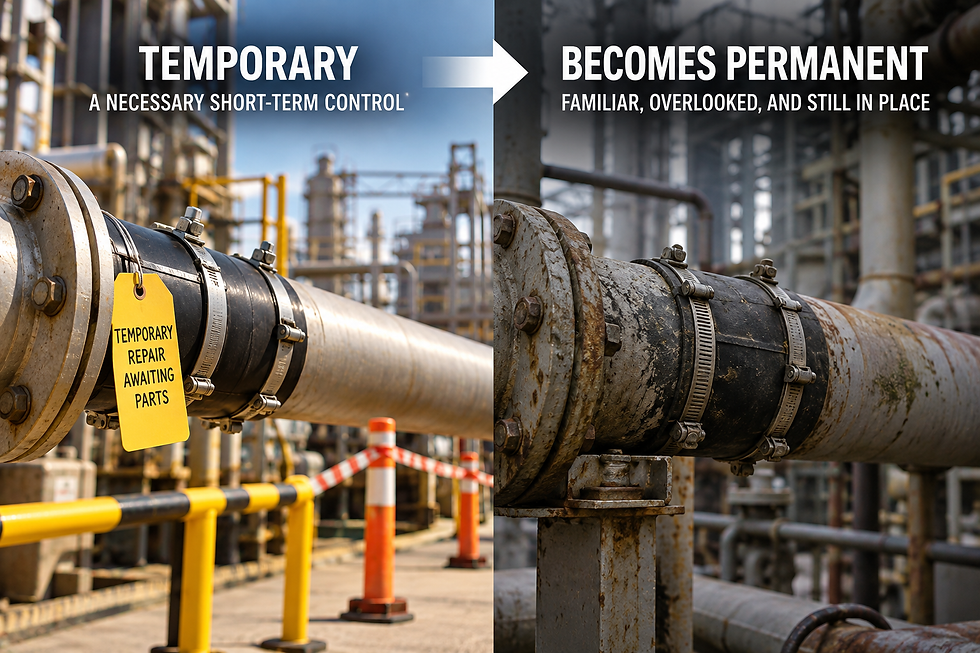
Temporary controls are useful. They keep work moving while teams repair, redesign, procure, investigate, or recover from a fault. The problem starts when “temporary” becomes the operating model.
A scaffold that stays for months. A bypassed trip awaiting parts. A temporary barrier protecting an excavation that expands into a long-term traffic plan. A jumper line installed for a shutdown that becomes part of daily production. A compensating control added after a failed inspection, then carried from shift to shift until nobody remembers the original defect.
High-risk industries run on control of change. Yet temporary arrangements often escape the discipline applied to permanent assets. They feel visible, familiar, and managed. That makes them dangerous.
Temporary Controls Are Not Weak by Definition
A temporary control is not automatically poor practice. Many are necessary.
A competent team may install temporary scaffolding for access to a pressure vessel. Maintenance may fit a short-term clamp on a low-risk utility line while a spool piece is fabricated. A construction team may use temporary edge protection during phased work. Operations may apply a temporary procedure while confirming a process hazard analysis recommendation.
These can be valid controls when they are engineered, authorized, inspected, time-bound, and actively managed.
The trap forms when a short-term control loses its temporary character. At that point, the organization may be carrying permanent risk without permanent design assurance.
Common examples include:
Temporary repairs to pipework, tanks, structures, guards, platforms, or electrical systems
Scaffolds left in service after the original task ends
Plastic barriers, cones, and tape replacing engineered separation
Disabled alarms, bypassed interlocks, defeated trips, or inhibited fire and gas detectors
Temporary operating procedures used beyond the condition that created them
Temporary piping, hoses, cables, pumps, generators, and lighting
Compensating controls after inspection findings or overdue maintenance
Interim staffing patterns after vacancies, turnover, or project delays
Short-term modifications made during shutdowns that remain after restart
The operational issue is clear. Temporary controls often depend more on human memory, local workarounds, and informal vigilance than permanent engineered safeguards. They also create new interfaces. A hose introduces routing, impact, compatibility, pressure, anchoring, and inspection concerns. A scaffold changes access, egress, dropped object risk, fire loading, and structural loading. A bypassed trip moves risk from automatic protection to human detection and response.
Those changes deserve formal attention.
OSHA’s Process Safety Management standard requires written procedures to manage changes to process chemicals, technology, equipment, procedures, and facilities, except for replacements in kind. The same principle appears across mature safety management systems and asset integrity models. ISO 45001 requires organizations to control planned and unintended changes that affect occupational health and safety performance. ISO 55000 frames asset management around lifecycle value, risk, and performance. These are not paperwork ideas. They are operating requirements.
Temporary does not mean exempt.
Why Temporary Arrangements Become Normal
Temporary controls become permanent through predictable mechanisms. None require negligence. Most grow from ordinary operational pressure.
Familiarity Reduces Attention
A temporary arrangement receives scrutiny when it appears. People stop, ask questions, add barricades, write permits, brief crews, and inspect the setup.
After several weeks, it becomes scenery.
The scaffold is “always there.” The bypass is “known.” The temporary generator becomes part of the normal sound of the site. Supervisors stop mentioning the exclusion zone because every crew has worked around it before.
Human factors research has described this drift for decades. Diane Vaughan’s work on the Challenger accident popularized the term “normalization of deviance,” referring to a process where departures from expected performance become accepted as normal when adverse outcomes do not immediately occur. Jens Rasmussen’s work on risk management also described how organizations migrate toward the boundary of acceptable performance under cost, workload, and production pressure.
These theories do not mean people become careless. They mean systems adapt. When a degraded condition continues without failure, confidence grows. The absence of an event starts to look like evidence of control.
It may only be evidence of luck, margin, or low exposure.
Ownership Becomes Unclear
Many temporary controls sit between departments.
Maintenance installed it. Operations uses it. Engineering plans the permanent fix. Procurement is waiting on parts. A contractor inspects the scaffold. HSE tracks the risk action. The project team owns the budget. Asset integrity owns the long-term consequence.
When ownership spreads across functions, nobody may own the closure date.
This is especially common with compensating controls. A pressure safety valve is found deficient, so a temporary operating limit is added. A guard is removed for maintenance, so a restricted access rule is introduced. An analyzer fails, so operators increase manual sampling. Each action may be reasonable. The ownership model may not be.
The practical question is not “Who knows about it?” It is “Who has authority, budget, and accountability to remove it?”
Expiry Controls Are Weak
Permit systems are often strong at the daily task level. They may not manage longer-term degradation well.
A permit to install temporary piping may close when installation ends. The temporary piping may then remain live. A scaffold inspection tag confirms periodic inspection. It may not ask whether the scaffold is still needed. A Management of Change record may authorize a temporary change for 30 days. If the change reaches day 31, the system may rely on manual follow-up.
That is a weak barrier.
Temporary controls need an expiry mechanism with teeth. A date only works if breach of that date triggers review, escalation, and decision-making. Otherwise it is an administrative label.
Personnel Changes Break Memory
Temporary controls rely heavily on context.
Why was that valve chained open? Why was this route closed? Why does the startup procedure include a manual verification that the old procedure did not require? Why is the temporary hose routed away from the cable tray?
The people who know may rotate off, resign, transfer, or move to the next project phase. Contractors demobilize. Shutdown teams leave. Commissioning specialists hand over to operations. Supervisors change shifts.
After that, the control may remain while its rationale disappears.
This is a known weakness in major hazard management. Official investigations across industries repeatedly identify poor handover, weak documentation, and loss of operational knowledge as contributors to serious events. The recommendations often differ, but the pattern is familiar.
Production Becomes Dependent on the Temporary State
The most dangerous temporary control is the one the plant now needs to meet schedule.
A bypass allows production to continue while a shutdown repair is deferred. A temporary platform allows access to valves that should be relocated. Interim staffing covers a specialist vacancy, then becomes the assumed labor model. A temporary procedure compensates for equipment unreliability, then becomes the way to hit output targets.
Once production depends on the temporary state, risk decisions become harder. Removing the control may mean downtime. Converting it to an engineered solution may require capital. Restoring the original safeguard may expose deferred maintenance.
At that point, the issue has moved from field control to business risk governance.
Evidence From Major Incidents Shows The Pattern
Temporary controls are rarely the sole cause of major accidents. They often appear as part of a wider pattern: degraded barriers, weak change control, poor communication, and normalization of abnormal conditions.
Several official investigations illustrate the risk.
Flixborough Showed The Danger Of Improvised Temporary Plant
The 1974 Flixborough disaster in the United Kingdom remains one of the clearest examples of a temporary modification escalating into catastrophic loss. A temporary pipe assembly was installed to bypass a leaking reactor in a cyclohexane oxidation plant. The subsequent failure released a large flammable inventory and led to a major explosion.
Official inquiry findings focused on the design and installation of the temporary bypass, weaknesses in engineering assessment, and management controls around plant modification. The details are specific to that plant and era, but the lesson still applies.
A temporary arrangement in process service can become the highest-risk component in the system if it lacks full engineering verification.
Modern Management of Change processes exist to prevent this type of uncontrolled modification. Yet the risk has not disappeared. Temporary piping, flexible hoses, clamps, jumpers, blinds, and bypasses remain common in maintenance and shutdown work. The engineering standard applied to them must match the hazard, not the expected duration.
Piper Alpha Highlighted Permits, Handover, And Equipment Status
The 1988 Piper Alpha disaster involved a chain of failures, including permit-to-work problems, communication weaknesses, and confusion over equipment status during maintenance. The Cullen Inquiry’s findings reshaped offshore safety regulation and emphasized systematic control of work, clear responsibilities, and effective permit systems.
Piper Alpha was not simply a “temporary control” accident. But it shows why temporary equipment conditions are so hazardous during shift change and simultaneous operations. A pump, valve, relief device, or safeguard that is temporarily out of service creates a dependency on information flow. If that information fails, the plant may be operated as if the safeguard exists.
Temporary status must be clear at the point of operation, not just in the permit office.
BP Texas City Showed Degraded Barriers And Organizational Drift
The U.S. Chemical Safety and Hazard Investigation Board’s investigation into the 2005 BP Texas City refinery explosion found serious deficiencies in process safety management, safety culture, siting, maintenance, and control of hazards. The event involved startup of an isomerization unit and a major release from a blowdown system, with occupied trailers located near the unit.
One relevant lesson is how degraded systems and temporary or nonideal arrangements can become accepted. Trailers intended for work support can become occupied exposure points. Equipment and instrumentation deficiencies can be tolerated. Procedures can become unreliable through repeated adaptation.
The CSB did not frame the event as a single temporary-control failure. Its broader findings matter more. Organizations can normalize layers of vulnerability until the system has little margin left.
Construction And Maintenance Carry The Same Logic
Construction sites often treat temporary works as a discipline in their own right. That is necessary because temporary structures can kill. Falsework, excavation support, scaffolding, lifting arrangements, temporary access, and temporary electrical systems all introduce design and inspection requirements.
The UK Health and Safety Executive and industry bodies have long emphasized that temporary works require competent design, coordination, inspection, and authorization. OSHA standards also address scaffolds, excavations, electrical safety, fall protection, and signs and barricades.
The same principle applies in maintenance. A temporary platform used for one valve replacement may be safe for that task. If the area becomes a routine operating route, the risk profile changes. Exposure frequency rises. Weathering, damage, unauthorized alteration, and dropped object potential increase. A temporary access solution may need to become a permanent platform, relocated valve, remote actuator, or redesigned maintenance strategy.
Why Conventional HSE Systems Miss The Trap
Many HSE systems are designed around tasks, incidents, audits, and compliance. Temporary controls often sit across those categories.
A permit system asks whether today’s job is safe. It may not ask whether a temporary arrangement has exceeded its approved duration.
An inspection system checks whether a scaffold is tagged. It may not ask whether the scaffold still belongs in the plant.
An incident action tracker closes recommendations once a compensating control is implemented. It may not track conversion to an engineered fix.
A risk register may capture the initial degraded condition. It may not update exposure after months of continued operation.
A Management of Change system may cover formal plant modifications. It may not catch temporary operating procedures, staffing workarounds, or field-built modifications introduced during urgent work.
That creates blind spots.
Management Of Change Must Include Temporary Change
Strong MOC systems distinguish between replacement in kind, temporary changes, emergency changes, and permanent modifications. They also define technical review, authorization level, documentation, pre-startup review, training, and closeout.
The failure mode is scope creep.
A valve bypass, alarm inhibit, procedural workaround, or temporary repair may be treated as maintenance rather than change. A staffing workaround may be treated as a resourcing issue rather than an operational risk. A field modification made during commissioning may be left for as-built updates later.
The practical test is simple. If the arrangement changes a barrier, operating envelope, maintenance method, exposure pattern, emergency response assumption, or inspection requirement, it belongs in a change control process.
Asset Integrity Programs Need Degradation Visibility
Asset integrity systems track inspection findings, corrosion rates, overdue maintenance, safety-critical elements, and impairment of protective systems. Temporary controls often appear when integrity has already degraded.
Examples include:
Pipe clamps after leaks or wall-thickness findings
Temporary supports after structural damage
Temporary firewater arrangements after pump or main defects
Bypassed instruments after reliability problems
Temporary HVAC or ventilation after system failure
Interim operating limits after relief, containment, or rotating equipment issues
The temporary control is only part of the story. The underlying degradation needs ownership, reassessment, and repair planning.
A temporary control should never hide an integrity defect from senior risk review. It should make the defect more visible.
Permit Systems Need Long-Term Memory
Permit-to-work is effective for work authorization, isolation, simultaneous operations, and hazard communication. It is weaker when used as a long-term control register.
If temporary controls rely on permits, the organization needs a bridge between permits and asset risk systems. That means live registers, shift handover, status boards at the work face, and links to MOC, maintenance management, and safety-critical impairment processes.
A closed permit must not equal a closed risk.
Warning Signs That Temporary Has Become Permanent
The temporary control trap usually gives warning before it produces an event.
Look for these signs in field verification, operational risk reviews, and leadership walkdowns:
The temporary control has survived more than one shift rotation, shutdown phase, or planning cycle.
Nobody can explain the original reason without checking old emails or calling someone offsite.
The closure date has passed, moved repeatedly, or was never defined.
The control has no single owner with decision authority.
The temporary arrangement has been modified by field crews.
Production plans assume the temporary state remains available.
Operators have adapted procedures around the arrangement.
Maintenance inspections confirm condition but not continued need.
The permanent repair depends on budget approval, outage access, or long-lead parts with no escalation.
The risk assessment has not been updated after exposure increased.
The temporary control appears in multiple systems with different owners.
New workers learn the temporary arrangement as “normal plant.”
One warning sign deserves special attention: language.
If teams say “that has always been there,” “we work around it,” “it is only temporary,” or “we just need it until the next outage,” ask for the MOC number, expiry date, inspection record, and repair plan. If those answers are unclear, the control is not temporary. It is unmanaged change.
A Practical Framework For Breaking The Trap
Temporary controls need a framework that is simple enough to use and strong enough to resist drift. The goal is not to ban temporary solutions. The goal is to manage them as live risk.
Control Element | Practical Requirement | Leadership Test |
Ownership | Assign one accountable owner with authority over risk, budget, and closeout. Name a deputy for shift or rotation coverage. | Who can approve removal, extension, or conversion? |
Expiry Date | Set a defined end date based on risk, not convenience. Require formal approval for extension. | What happens automatically when the date is reached? |
Technical Basis | Document the engineering or competent-person assessment. Define limits, assumptions, and excluded uses. | What would make this control invalid? |
Inspection | Define inspection frequency, acceptance criteria, and records. Include after weather, impact, process upset, or configuration change. | Who verifies that the control still works? |
Risk Reassessment | Reassess when duration, exposure, staffing, process conditions, or nearby work changes. | Has the risk changed since approval? |
Escalation | Trigger senior review when the control exceeds duration, affects safety-critical barriers, or supports production. | When does this become a management decision? |
Communication | Include status in handover, permits, labels, drawings where needed, and field briefings. | Would a new supervisor understand the risk today? |
Closeout | Remove, restore, or convert through permanent engineered change. Update documents and verify field condition. | What evidence proves the temporary state is gone? |
Define The Class Of Temporary Control
Not every temporary control needs the same rigor. A short-term sign or pedestrian barrier does not require the same review as a bypassed safety instrumented function.
Classify temporary controls based on consequence and barrier impact. A practical classification can include:
Low-risk temporary controls with local supervision and routine inspection
Moderate-risk controls requiring documented risk assessment and assigned ownership
High-risk controls affecting process containment, structural stability, energization, lifting, confined spaces, fire protection, emergency systems, or safety-critical equipment
Critical temporary impairments requiring senior authorization, MOC, technical authority review, contingency planning, and short expiry
The classification should determine approval level, inspection frequency, and extension rules.
Make Expiry Dates Hard To Ignore
An expiry date buried in a form is not enough.
Use visible and system-based controls:
Temporary control register reviewed at daily or weekly operations meetings
Automatic alerts before expiry
Escalation to asset manager, project manager, or site leader after expiry
Prohibition on informal extensions
Risk owner sign-off for continued operation
Clear field tags showing status, owner, and review date where appropriate
The review should ask more than “Can we extend?” It should ask whether the temporary arrangement has become part of production and whether a permanent engineered solution is now required.
Treat Extensions As New Risk Decisions
Repeated extension is a major warning sign.
Each extension should trigger a fresh risk review. Do not copy the original assessment forward without challenge. Review actual exposure, inspection findings, near misses, degraded assumptions, changes in personnel, adjacent work, weather, corrosion, vibration, fatigue, and operational dependency.
For a temporary pipe spool, that might include supports, vibration, pressure cycling, compatibility, leak testing, mechanical protection, inspection access, and emergency isolation. For temporary staffing, it might include fatigue, competence coverage, supervision ratios, emergency response, and backlog growth.
The longer the arrangement stays, the less useful the original “short-term” risk judgment becomes.
Link Temporary Controls To MOC And Asset Integrity
Temporary control registers should not sit outside formal systems.
Connect them to:
MOC numbers and approval records
Maintenance work orders
Inspection findings
Safety-critical equipment impairment records
Permit-to-work systems
Process hazard analysis recommendations
SIMOPS plans
Emergency response assumptions
Drawings, procedures, and operating limits
This prevents a common failure. One system shows a temporary control as active. Another shows the repair action as closed. A third shows no open risk. The plant still carries the hazard.
Convert Recurring Temporary Controls Into Permanent Solutions
If the same temporary control appears repeatedly, the problem is not temporary. It is a design, maintainability, reliability, planning, or resourcing issue.
Examples include:
Repeated scaffolding for routine valve access
Frequent bypass of unreliable instrumentation
Temporary hose routing used every shutdown
Repeated manual sampling due to analyzer failures
Temporary barriers around recurring leaks or drainage failures
Interim supervision because a role remains unfilled
Temporary operating limits used after every startup problem
These patterns justify engineered fixes. That may mean permanent access platforms, valve relocation, instrument upgrade, redesigned isolation points, better drainage, spare parts strategy, staffing model changes, or new process control logic.
NIOSH’s Prevention through Design approach supports this logic. Hazards are best addressed early through design and engineering, not controlled indefinitely through administrative workarounds.
Leadership Questions That Expose Drift
Senior leaders do not need to inspect every tag. They need to ask questions that reveal whether the system controls temporary risk.
Use questions like these during reviews and site visits:
What are the top temporary controls currently keeping this asset operating?
Which temporary arrangements affect safety-critical barriers?
Which temporary controls have exceeded their original expiry?
How many have been extended more than once?
Which ones now support production or schedule commitments?
What is the oldest temporary repair on this site?
Which temporary procedures are being used by new personnel as normal work?
How do we know closed permits did not leave open risk?
What budget or outage constraints are delaying permanent repair?
Which temporary controls should be converted into engineered design changes?
Who has authority to stop further extension?
These questions move the issue from compliance to governance. That matters. Temporary controls often continue because the people closest to the work can manage the immediate hazard but cannot remove the business constraint that keeps it in place.
What Good Looks Like In Practice
A mature organization handles temporary controls with the same seriousness it applies to other risk-bearing changes.
It keeps a live register. It classifies risk. It sets expiry dates. It assigns owners. It links to MOC, permits, asset integrity, and work management. It inspects based on hazard. It reviews extensions as new decisions. It escalates overdue controls. It closes the loop with field verification.
More than that, it challenges dependency.
If a temporary repair allows production to continue, the site leadership team sees it as a risk decision. If temporary scaffolding becomes routine access, engineering evaluates a permanent platform. If a bypass is needed beyond a short approved period, technical authorities review the operating envelope. If interim staffing becomes structural, senior management treats it as an operational resilience issue, not a local roster problem.
This is where safety management becomes real. It connects field conditions to decisions about design, money, outage planning, maintenance strategy, and production.
Temporary Controls, Permanent Risk is not a slogan. It is a warning about organizational memory. A control that starts as a short-term protection can become a hidden feature of the system. Once that happens, the risk is no longer temporary. It is embedded.
Professional References And Further Reading
OSHA Process Safety Management Standard, 29 CFR 1910.119 Requirements for managing process safety hazards, including Management of Change.
U.S. Chemical Safety and Hazard Investigation Board Official investigation reports and videos covering major process safety incidents, including BP Texas City and other refinery and chemical events.
The Cullen Inquiry Into The Piper Alpha Disaster Key findings on offshore safety management, permit-to-work control, communication, and regulatory reform.
UK Health and Safety Executive Guidance and investigation material on major hazards, temporary works, maintenance, management of change, and asset integrity.
ISO 45001 Occupational Health And Safety Management Systems International standard addressing planning, operational control, change, and continual improvement.
ISO 55000 Asset Management Framework for managing asset risk, lifecycle performance, and decision-making.
NIOSH Prevention Through Design Guidance and research promoting hazard elimination and risk reduction through design choices.
Human Factors And Safety Science Research Key work by Diane Vaughan on normalization of deviance and Jens Rasmussen on organizational drift and risk boundaries.
Professional Takeaway
Temporary controls are often necessary. They are also easy to normalize.
Treat every temporary repair, bypass, scaffold, barrier, procedure, staffing workaround, and compensating control as a live risk decision. Give it an owner. Set an expiry date. Inspect it. Reassess it when conditions change. Escalate it when it supports production. Convert it to a permanent engineered solution when recurrence or duration proves the problem is not temporary.
The real failure is not using a temporary control. The failure is letting it become part of normal operations without admitting that the risk has changed.


