
The Competence Illusion: Why Training Records Don't Prove Someone Is Competent

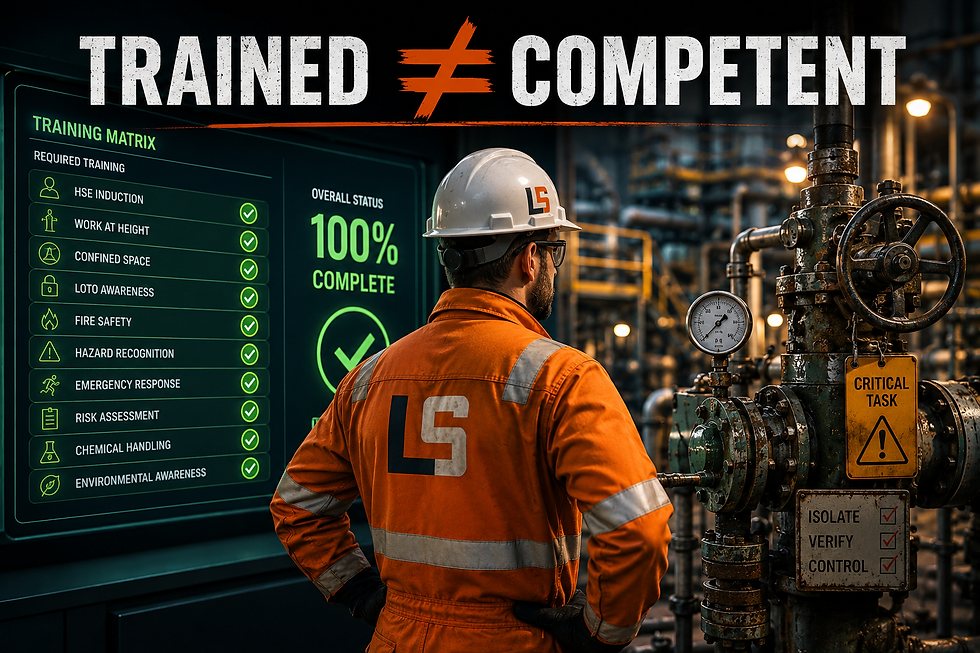
Open almost any mature organisation's learning management system and you will find an impressive amount of information. Employees have completed inductions.
Mandatory courses are current. Certificates have been uploaded. Refresher dates are scheduled. Training matrices are populated and dashboards show compliance percentages approaching 100 per cent.
From a management perspective, it can be reassuring.
But there is a question the training records cannot answer: Can these people actually do the job safely?
That is a very different question.
One of the most persistent weaknesses in HSE management is the tendency to treat training and competence as though they are interchangeable. Someone attends a course, passes a test, receives a certificate and is subsequently recorded as competent.
The administrative process is complete, but the organisation may have established little more than evidence that the person attended training and demonstrated knowledge at a particular point in time.
Training matters enormously. Qualifications matter. Experience matters. None of them, individually, proves competence.
Competence becomes visible when people can apply what they know to the work they are actually required to perform, including when conditions change, problems emerge and decisions become less straightforward.
For organisations managing serious risk, that distinction is not academic. It can be the difference between having a trained workforce and having a capable one.
Training Is an Input, Not the Outcome
The purpose of training is to develop knowledge and skills. The purpose of competence assurance is to establish whether someone can apply the necessary knowledge, skills and experience to perform their responsibilities to the required standard.
Those objectives are connected, but they are not identical.
The UK Health and Safety Executive defines competence in terms of skills, experience and knowledge and makes the distinction particularly clear: training is an important part of establishing competence, but training alone is not sufficient. Practice, experience and the ability to apply learning are also important. HSE guidance also emphasises that competence should relate to the actual responsibilities, activities and tasks identified through risk assessment.
This sounds obvious when stated plainly. Yet organisational systems routinely blur the distinction.
A worker completes working-at-height training, so the training matrix turns green. A supervisor completes incident-investigation training and is added to the investigation team. A manager attends a risk-management course and is considered capable of leading risk reviews. An employee completes an online emergency-response module and becomes compliant with the organisation's training requirement.
Each of those activities may be appropriate.
But what has actually been demonstrated?
Primarily, that training occurred.
The organisation still needs to establish whether the individual can apply that learning effectively in the environment where it matters.
The Certificate Problem
Certificates are useful evidence. They demonstrate that someone completed a defined programme or achieved a particular qualification. For certain roles, licences, certifications and formal qualifications are essential.
The mistake is allowing the certificate to become a substitute for judgement.
A certificate cannot tell you whether someone has performed the task recently. It cannot tell you whether their experience is relevant to the specific equipment or operating environment. It cannot establish whether they recognise when a situation has moved beyond their capability. It may not demonstrate how they respond when the task stops following the textbook.
Two people can hold the same qualification and have dramatically different levels of operational capability.
One may have spent ten years routinely applying the skill in complex environments. The other may have completed the course six months ago and barely used the skill since.
Administratively, both boxes may be green.
Operationally, they are not necessarily equivalent.
HSE guidance recognises exactly this issue, describing competence as a combination of training, skills, experience, knowledge and the ability to apply them to perform work safely. It also notes that the competence required varies according to the task and circumstances. Someone competent for straightforward work may require additional supervision or experience before undertaking more complex work.
That should make us cautious about any competence system that relies predominantly on certificates.
Competent for What?
Perhaps the most important question in competence management is also one of the simplest: competent to do what?
Competence should not be treated as a permanent characteristic of an individual.
Someone is competent to perform particular activities, under particular conditions, to a defined standard.
An experienced crane operator may be highly competent in routine lifting operations but lack the experience required for an unusually complex lift. A supervisor may be excellent at managing normal production activities but have limited experience coordinating a major shutdown involving multiple contractors and simultaneous operations. An HSE professional may be highly capable in occupational safety but have limited competence in process safety, industrial hygiene or environmental risk.
Even within the same profession, competence is contextual.
This is why job titles make poor substitutes for competence assessment. So do years of experience.
Twenty years in an industry can indicate substantial capability, but only if the experience is relevant. Twenty years of repeating essentially the same work is different from twenty years involving increasing complexity, broader responsibility, exposure to abnormal situations and continual professional development.
The question should therefore not be, “Is this person competent?”
It should be, “Is this person competent to perform this task, in these conditions, with this level of risk and responsibility?”
That framing produces a much stronger conversation.
Routine Work Can Hide Weakness
Competence is easiest to overestimate when everything is going well.
Routine operations provide familiar cues. Equipment behaves normally. Experienced colleagues are nearby. Procedures apply reasonably well. Problems are familiar and solutions have been used before.
Under those circumstances, someone with limited competence may still perform adequately.
The real test often appears when conditions change.
Equipment fails unexpectedly. The normal supervisor is unavailable. The job encounters a condition not covered clearly by the procedure. Several activities begin interacting. An emergency develops. A contractor asks for a deviation. Time pressure increases.
Now the individual must interpret information, recognise limits, make decisions and know when to stop and seek assistance.
This is why competence assurance for safety-critical roles must consider abnormal, infrequent and emergency conditions rather than assessing only routine task execution.
HSE specifically identifies foreseeable operating conditions, including complex and infrequent activities, maintenance, emergencies and process upsets, as relevant considerations in competence assurance.
A person who can perform perfectly when everything follows the plan may not yet be competent to manage the situations where the plan stops working.
And those situations are often where competence matters most.
The Forgotten Role of Experience
Modern organisations have become very good at formal learning.
We can deploy online courses globally, track attendance automatically, issue digital certificates and generate real-time compliance dashboards. These capabilities are valuable, particularly across geographically dispersed organisations.
But competence cannot be downloaded.
Some knowledge only becomes meaningful through application.
An employee learns the principle in training, sees it applied under supervision, attempts the task, receives feedback, repeats it and gradually develops judgement. Over time, they encounter variations and exceptions that deepen their understanding.
This is why coaching, mentoring, supervised practice and structured on-the-job development remain so important.
Experienced workers frequently carry knowledge that is difficult to capture in a slide deck or e-learning module. They know what abnormal equipment sounds like. They recognise when conditions “don't look right.” They understand the subtle indicators that a job is beginning to move outside normal parameters. They know which apparently minor changes deserve attention because they have seen what happened previously.
The challenge is to transfer that experience deliberately rather than hoping new employees absorb it through proximity.
HSE guidance recommends structured on-the-job training linked to risk assessments and control measures, with additional methods such as classroom learning or simulation where appropriate for safety-critical environments.
That is a considerably richer model than “course completed.”
Competence Also Has a Shelf Life
Another weakness in many competence systems is the assumption that once competence has been achieved, it remains indefinitely unless a certificate expires.
Real capability does not work that way.
Skills deteriorate when they are not used. Knowledge becomes outdated. Equipment changes. Procedures change. Technology changes. People move into management roles and stop performing technical tasks regularly.
Someone may remain highly qualified while becoming progressively less current.
This is particularly relevant for activities performed infrequently. Emergency-response skills are an obvious example. An employee may have demonstrated a capability two years ago but never practised it since.
Would we still expect the same level of performance under pressure?
Competence assurance should therefore include maintenance as well as initial achievement. HSE guidance specifically identifies refresher training and reassessment as considerations for infrequent, complex and safety-critical tasks, while other HSE guidance notes that skills can decline when they are not regularly used.
The frequency and depth of reassessment should follow risk, not administrative convenience.
A low-risk office task does not require the same assurance regime as operating safety-critical equipment or making decisions capable of affecting a major hazard.
Managers Need Competence Too
Competence discussions often focus disproportionately on frontline workers.
That is a mistake.
Managers make decisions that can create or remove risk on a much larger scale.
They approve resources. Set schedules. Select contractors. Authorise organisational changes. Review performance. Decide whether equipment remains in service.
Determine staffing levels and influence the conditions under which frontline employees work.
A technically competent workforce operating inside a poorly managed organisation can still be exposed to significant risk.
Management competence therefore matters just as much as worker competence, although the required capabilities are different.
Does a project manager understand the HSE implications of accelerating a schedule?
Can a procurement manager recognise why selecting the lowest-cost contractor may introduce additional operational risk? Can a senior executive interpret process-safety information? Does a supervisor understand when operational pressures are beginning to undermine critical controls?
HSE's management guidance explicitly includes managers and responsible job holders within competence arrangements and, for process industries, highlights the importance of technical competence in process safety management.
Yet many organisations require extensive competency assessment for someone operating equipment while providing relatively little HSE capability development for the manager making decisions about the entire operation.
That imbalance deserves attention.
Competence Is Also Organisational
There is another dimension that individual training records cannot capture.
An organisation can employ highly competent individuals and still perform poorly if the surrounding system prevents them from applying that competence.
People need adequate resources, suitable equipment, clear responsibilities, realistic workloads, effective supervision and enough time to perform their responsibilities properly. HSE's current HSG65 guidance explicitly includes sufficient time alongside training, skills, knowledge and experience when describing effective competence arrangements.
This matters because organisations sometimes diagnose performance problems as competence deficiencies when the real problem is elsewhere.
A supervisor may know exactly what should be done but be responsible for too many simultaneous activities. A maintenance technician may be technically competent but working with inadequate information. A manager may understand the risk but lack authority to obtain the resources required to control it.
Sending these people back to training will not solve the problem.
Before prescribing another course, ask whether the issue genuinely involves knowledge or skill. Sometimes it does. Sometimes the organisation needs to fix the conditions surrounding the work.
From Training Matrix to Competence Assurance
None of this means organisations should abandon training matrices.
They remain useful tools for identifying mandatory requirements, tracking development and managing refresher programmes.
But they should be understood for what they are: evidence of part of the competence process, not proof of the final outcome.
A stronger competence assurance system begins with risk and role requirements. What must this person be able to do? What could happen if they cannot do it effectively?
What knowledge, skills, experience and behaviours are required? How will those capabilities be developed? How will they be demonstrated? Who is qualified to assess them? How will competence be maintained?
The assessment method should then reflect the risk.
For some activities, completion of training and a knowledge check may be entirely proportionate. For others, direct observation, practical demonstration, simulation, supervised task completion, scenario-based assessment or formal verification may be necessary.
The more safety-critical the responsibility, the stronger the evidence should be.
This principle is reflected in HSE guidance, which recommends that competence assessment methods be appropriate to the hazard profile and that assurance for safety-critical tasks should be more robust.
The objective is not to create another enormous administrative system.
It is to obtain enough evidence to answer the question that actually matters.
Can this person perform the work safely and effectively?
Stop Asking Whether the Training Is Complete
Training completion is useful information.
It just isn't the same as competence.
Organisations need both.
They need structured training to develop knowledge and skills, practical opportunities to apply learning, experienced people who can coach and mentor others, appropriate assessment methods and ongoing assurance that capability is being maintained.
They also need the humility to recognise that competence has limits.
One of the characteristics of genuinely competent people is often that they know when they have reached theirs.
They recognise unfamiliar conditions. They understand when additional expertise is required. They stop before uncertainty becomes uncontrolled risk.
That capability is difficult to represent as a green cell in a training matrix.
But it may be one of the most important capabilities the organisation possesses.
The next time the dashboard reports 100 per cent mandatory training compliance, celebrate it if it represents genuine effort and achievement.
Then ask the more important question:
How do we know our people can actually do what we are relying on them to do?
If the only answer is that everyone has a certificate, the organisation may know considerably less about its competence than it thinks.
References and Further Reading
UK Health and Safety Executive (HSE). Training and Competence – Human Factors. Guidance on competence assurance, including the relationship between training, practice, experience, assessment, safety-critical tasks and abnormal operating conditions.
UK Health and Safety Executive (HSE). Managing for Health and Safety (HSG65). Guidance on organisational competence, including training, skills, knowledge, experience, responsibilities and the resources and time necessary to fulfil them.
UK Health and Safety Executive (HSE). Competence in Health and Safety. Guidance and industry resources addressing competence, conformity assessment and competence assurance.
Energy Institute. Human Factors Briefing Note No. 7 – Training and Competence. Guidance addressing training, competence and the importance of competent personnel in maintaining safe operations.
US Occupational Safety and Health Administration (OSHA). Recommended Practices for Safety and Health Programs – Education and Training. Guidance on role-specific training, hazard recognition, controls and adapting training when tasks, equipment, processes or working conditions change.


