
Why Skilled Workers Freeze in Emergencies and How Training Reduces Startle Risk

A skilled operator can do everything right for years, then hesitate for two seconds when a valve ruptures, an alarm floods the panel, or a machine moves in a way no one expected.
That pause is not weakness. It is a predictable human response to surprise, threat, noise, time pressure, and uncertainty. In high-risk workplaces, the problem is not that trained people lack discipline. The problem is that sudden unexpected events can disrupt the brain systems people rely on to notice, think, decide, and act.
The goal is not to remove startle. That is impossible. The goal is to reduce the chance that startle turns into freezing, tunnel vision, fixation, or a bad decision.
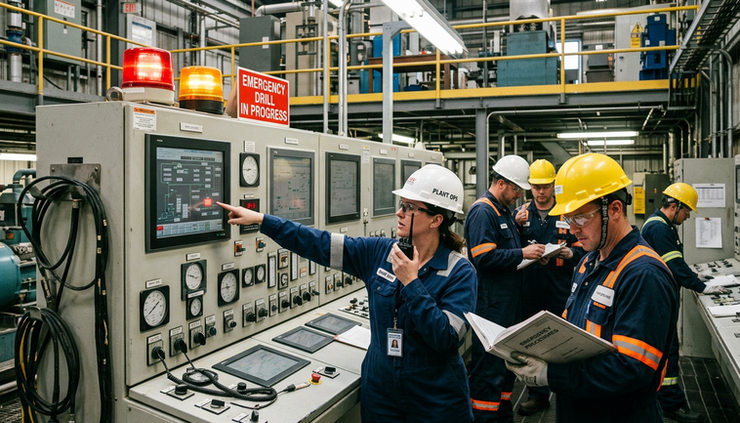
Sudden Events Disrupt The Brain Before Training Can Catch Up
Startle is a fast, automatic reaction to an unexpected stimulus. It can come from sound, motion, impact, loss of control, a flash, a blast, a warning tone, or a sudden change in system behavior. The response begins before conscious analysis.
That matters in high-risk work. A refinery operator, pilot, firefighter, utility lineman, surgeon, offshore worker, police officer, rail controller, or crane operator may have excellent knowledge. Yet the first moments after a surprise can still be messy.
The nervous system is built to protect the body first. It does not begin with a calm review of the procedure.
The basic sequence often looks like this:
A sudden event grabs attention.
The body triggers an alarm response.
Heart rate, muscle tension, and breathing change.
Attention narrows toward the most threatening or obvious cue.
Working memory loses capacity.
The person may freeze, act reflexively, or reach for a familiar pattern.
Only after a short delay does deliberate reasoning regain control.
This is why some people describe an emergency as “unreal” or “too fast.” It is also why voice recordings from crashes, fires, and industrial accidents often show confusion during the first seconds.
The startle response has a real neurological basis. Joseph LeDoux’s work on fear and threat processing showed that the amygdala plays a central role in rapid threat detection. The amygdala can trigger defensive reactions before the cortex finishes detailed interpretation. That fast route is useful when survival depends on speed. It also creates risk when the situation requires accurate diagnosis.
Amy Arnsten’s research on stress and the prefrontal cortex is also relevant. Under acute stress, high levels of catecholamines can weaken prefrontal cortex functions. Those functions include working memory, impulse control, planning, and flexible decision-making. Stress shifts control toward more automatic, habit-based responses.
That shift can help when the correct response has been practiced often and matches the event. It can hurt when the event is rare, complex, or different from the drill everyone knows.
A useful way to think about this is simple:
Under Moderate Pressure | Under Sudden Extreme Pressure |
Attention stays flexible | Attention narrows |
Working memory holds several cues | Working memory drops details |
People compare options | People reach for familiar actions |
Communication stays clearer | Communication may become clipped or absent |
Procedures are easier to recall | Steps can be skipped or mixed |
The Yerkes-Dodson law, first described in 1908, is often used to explain this effect. Performance can improve with arousal up to a point. Past that point, performance declines. Complex tasks suffer sooner than simple tasks. That is exactly the kind of task found in many emergencies.
High-risk workplaces often involve complex systems, ambiguous cues, and fast consequences. During a sudden event, the brain may not fail completely. It may perform the wrong kind of processing for the problem at hand.
Freezing Is Often A Defensive Response, Not A Lack Of Skill
Freezing is one of the least understood emergency behaviors. People often describe it as panic. That is too vague. A freeze can be a defensive pause, an attentional lock, or a brief failure to select an action.
Animals freeze when detecting danger because movement may increase risk. Humans can show a related response. In the workplace, freezing may look like:
Staring at an alarm panel without acting
Holding a tool or control but not using it
Repeating a question
Watching the hazard while missing escape routes
Waiting for confirmation when action is needed
Continuing a routine task after conditions have changed
Freezing is not always full immobility. It may be a pause in thinking. A worker may move, speak, or look busy while failing to update the mental model.
Mica Endsley’s model of situational awareness helps explain this. Situational awareness has three levels:
Perception
Noticing the relevant cues.
Comprehension
Understanding what those cues mean.
Projection
Anticipating what will happen next.
Startle can break any of these levels. A person may see the flashing warning but miss the pressure trend. They may hear the alarm but fail to understand that it points to a cascading failure. They may understand the current danger but fail to predict that a second hazard is about to emerge.
This is how experienced people lose the picture.
The issue is not usually ignorance. It is disruption. Under extreme stress, attention narrows. Easterbrook’s cue-utilization theory proposed that arousal reduces the range of cues people use. Under pressure, people focus on central cues and drop peripheral ones. That can help if the central cue is correct. It can be dangerous if the peripheral cue is the key to the emergency.
A worker may focus on a fire and miss the wind direction. A pilot may focus on airspeed and miss aircraft attitude. A control room operator may focus on the first alarm and miss the root cause. A nurse may focus on one changing vital sign and miss a medication interaction.
Freezing also connects to decision conflict. In a normal task, experience creates strong patterns. Gary Klein’s recognition-primed decision model describes how experts often make fast decisions by matching the situation to patterns they have seen before. They do not always compare options like a classroom textbook suggests. They recognize, simulate, then act.
That works well when the pattern is clear.
It works poorly when the event is novel or misleading.
In a rare emergency, two competing patterns may appear at once. The person senses danger but cannot classify it. That creates a stall. The brain searches memory for a match. If no match appears, action may stop.
Freezing is often a recognition problem. The person knows many correct actions, but the situation has not yet sorted itself into a known pattern.
This also explains why “more experience” does not always protect people. Experience is powerful when it includes rare and abnormal events. Experience is less protective when someone has repeated normal operations for years with few serious disruptions.
A technician who has started a machine safely 10,000 times may be highly skilled at normal start-up. That does not mean they have practiced a sudden hydraulic failure with noise, fluid spray, alarms, and a coworker in the danger zone.
Skill is specific. Stress exposes that fact.

Experienced Personnel Make Poor Decisions When The Situation Changes Faster Than The Mental Model
Poor decision-making during emergencies often begins with a mental model that is wrong, incomplete, or outdated.
A mental model is the person’s internal explanation of the system. It answers three questions:
What is happening?
Why is it happening?
What will happen next?
Sudden events damage mental models in several ways.
The First Explanation Can Take Over
People tend to anchor on the first plausible explanation. This can happen fast during an emergency. Once a person thinks, “This is a sensor failure,” they may discount evidence that points to a real process failure.
This is not stupidity. It is a known cognitive shortcut. In high-tempo environments, the brain reduces complexity by selecting a workable story. The danger comes when that story becomes sticky.
Accident investigations often find fixation. Crews or operators kept pursuing one explanation while other cues appeared. Aviation has many documented examples. The 2009 Air France Flight 447 accident report by France’s BEA described confusion, loss of reliable airspeed information, high workload, and failure to recognize the aircraft’s aerodynamic stall for a critical period. The case remains a major example in discussions of startle, automation surprise, and loss of aircraft state awareness.
Industrial and medical work show similar patterns. A team may treat a visible symptom while missing the system-level failure. An operator may trust an automatic control system longer than conditions justify. A supervisor may delay shutdown because the event does not fit past experience.
Alarm Floods Overload Working Memory
Many high-risk systems produce too much information during abnormal events. A single failure can trigger dozens or hundreds of alarms. Operators then face a second emergency: figuring out which signal matters.
Working memory is limited even in calm conditions. Under stress, its capacity drops. That makes alarm design a safety issue, not a convenience issue.
The Three Mile Island accident in 1979 is a common example in human factors. Operators faced confusing indications and multiple alarms. They misread the state of the reactor cooling system, in part because the interface did not make the true condition clear. The event helped drive decades of work on control room design, alarm management, and human-system interaction.
A bad interface can turn a trained worker into a guesser.
Stress Shifts People Toward Habit
Stress increases the appeal of actions that are familiar, fast, and motor-based. That is why people may reach for a usual control, follow a normal checklist, or continue a routine sequence even when the event is abnormal.
This is linked to the shift from deliberate control to habit-based behavior under stress. Research in neuroscience and psychology has shown that stress can bias behavior away from flexible planning and toward learned routines. In emergency work, that can be valuable if the routine is correct. It can be dangerous if the situation demands adaptation.
This is why training must build the right habits, not just knowledge.
Authority Gradients And Social Pressure Can Delay Action
Emergencies happen inside teams. Social forces affect decisions.
A junior worker may see a hazard but hesitate to challenge a senior person. A control room operator may wait for a supervisor. A firefighter may hold back a concern because the crew has already committed. In healthcare, aviation, and energy operations, this pattern is well known.
Crew Resource Management, first developed in aviation and later adapted to other fields, addresses this directly. It teaches communication, challenge-response behavior, workload sharing, and decision review. The evidence base includes work by NASA and aviation safety researchers, along with later team training research by Eduardo Salas and colleagues.
The goal is not politeness. The goal is to make critical information move fast, across rank and role.
Time Pressure Can Create Premature Closure
Premature closure happens when a person stops diagnosing too early. Under time pressure, closing the problem feels productive. The person chooses a plan and acts.
That is sometimes necessary. Waiting for perfect information can be fatal.
The risk is closing before checking the cues that would disprove the plan. High-reliability teams fight this with short diagnostic habits:
“What are we missing?”
“What has changed?”
“What is the worst credible next event?”
“What cue would prove this wrong?”
“Who has a different read?”
These questions take seconds. They can prevent fixation.

Realistic Drills Reduce Startle By Building Familiarity With The Unfamiliar
Training cannot stop the first jolt of startle. It can shorten it. It can also make the first useful action more likely.
The strongest training does more than repeat normal procedures. It exposes workers to variability, surprise, noise, time pressure, role conflict, and incomplete information. That kind of practice is often called stress exposure training, scenario-based training, simulation training, or high-fidelity rehearsal.
Research reviews by James Driskell, Joan Johnston, and others have found that stress exposure training can improve performance under pressure when it includes preparation, exposure, and feedback. The training must be controlled. Throwing people into chaos without structure can teach bad habits or create false confidence.
Good startle-risk training has three parts.
Prepare People For The Stress Response
People perform better when they know what startle does to the body and mind. This should be direct and practical.
Training should explain:
Heart rate and breathing may change.
Hands may shake.
Hearing may narrow.
Vision may lock onto one cue.
Speech may become short or delayed.
Memory may drop steps that felt automatic in class.
The first explanation may be wrong.
This knowledge reduces shame. It also gives people a recovery plan.
A simple recovery pattern can help:
Stop the automatic action if it is unsafe.
Breathe once or twice on purpose.
Name the event out loud.
Confirm the critical cue.
Start the trained response.
The point is not relaxation. The point is control.
Expose Teams To Realistic But Safe Surprise
The brain needs experience with rare events before the real event happens. Slide decks do not create that experience. Tabletop exercises help with reasoning, but they do not fully test attention, coordination, communication, and motor response.
Realistic drills should include:
Unexpected alarm sequences
Equipment noise
Protective gear
Reduced visibility
Conflicting information
Missing team members
A simulated casualty or rescue constraint
Time pressure
Communication failures
Handovers between teams
The drill does not need Hollywood theatrics. It needs the right friction.
A control room simulation might include a sensor fault that masks a real process deviation. A hospital simulation might include a deteriorating patient with an equipment issue. A utility crew drill might include a weather change and an unexpected energized component. An aviation simulator might introduce automation behavior that does not match crew expectations.
Simulation-based training has strong support in aviation, anesthesia, emergency medicine, and other high-consequence fields. David Gaba’s work helped establish simulation as a major tool in anesthesia crisis resource management. William McGaghie and colleagues have published widely on simulation-based mastery learning in healthcare. The key lesson transfers across industries: people need repeated practice with feedback until performance reaches a defined standard.
Debrief The Decision Process, Not Just The Outcome
Many organizations judge drills by whether the team “completed” the exercise. That misses the point.
A useful debrief asks:
When did the first cue appear?
What did people think it meant?
What cue was missed?
When did the team update its mental model?
Who spoke up?
Was the procedure easy to use under stress?
Which step caused delay?
What action should become automatic?
What needs redesign?
The best debriefs are specific and non-punitive. They focus on work as done, not work as imagined. Sidney Dekker and other safety researchers have pushed this distinction for years. Real work includes tradeoffs, shortcuts, weak signals, and local adaptations. Drills reveal those details.
Punitive debriefs destroy learning. If people fear blame, they hide confusion and near-misses. That preserves the risk.
Practice Recovery From Surprise
Many drills begin after the emergency is known. That skips the critical part.
Startle risk lives in the transition from normal to abnormal. Training should practice that transition.
For example, instead of telling the crew, “You are responding to a pump failure,” begin with normal work. Then introduce weak cues, followed by a sudden change. Watch when the team notices, how they classify it, and how they shift roles.
The starting point matters. People need practice leaving the routine.
Train Recognition And Rule-Based Response Together
Jens Rasmussen’s skill-rule-knowledge framework is useful here. People operate at different levels:
Skill-based behavior
Fast, practiced actions with little conscious thought
Rule-based behavior
If-this-then-that procedures and checklists
Knowledge-based behavior
Reasoning through novel problems
Emergencies may require all three. A worker may need a fast motor action, a checklist step, and a diagnostic judgment.
Training should make clear which actions must be automatic and which require confirmation. For example, an emergency stop may be automatic when a person is in a pinch point. By contrast, a complex process shutdown may require defined verification to avoid making the event worse.
The wrong training can make people fast and unsafe. The right training makes them fast where speed matters and deliberate where diagnosis matters.
Procedures And Work Design Should Help The Brain Under Stress
Training is not enough. Procedures, interfaces, and job design must account for human limits during startle.
Many organizations try to solve human error by adding more instructions. That often backfires. Under pressure, long procedures become unusable. The problem is not worker discipline. The problem is design.
Procedures must be built for emergency cognition.
Make The First Actions Unmistakable
The first page of an emergency procedure should answer one question:
What must be done now to prevent death, serious injury, or catastrophic loss?
Those actions should be short, visible, and practiced. They should not be buried under background, definitions, or administrative text.
Good emergency procedures use:
Clear triggers
Short steps
Plain verbs
Critical cautions near the step
Confirmation points
Role assignments
Branch points that are easy to follow
Stop points when the situation is unclear
A procedure that requires careful reading during alarm flood is a weak barrier.
Use Design To Reduce Memory Load
A person under startle should not need to remember a long sequence from training. The workplace should cue the right behavior.
Examples include:
Color-coded isolation points
Consistent valve direction and labeling
Physical guards that prevent wrong movement
Checklists placed where the task occurs
Alarm priorities that separate urgent from advisory signals
Distinct tones for different classes of emergency
Status displays that show system state, not just component state
Emergency equipment stored in predictable positions
Human factors engineering has supported these design ideas for decades. James Reason’s work on organizational accidents made a clear point: accidents usually come from layers of failed defenses, not one bad worker. Better design creates better defenses.
Control Alarm Floods Before They Happen
Alarm management is central to startle risk. A system that screams everything at once forces workers to triage under stress.
Good alarm systems should:
Prioritize alarms by consequence and urgency
Suppress nuisance alarms
Group related alarms
Identify the likely initiating event when possible
Show trends needed for diagnosis
Avoid using the same tone for every condition
Support quick acknowledgment without hiding critical information
Standards and guidance such as ISA-18.2 and EEMUA 191 are widely recognized in process industries. They focus on alarm system lifecycle management, rationalization, performance monitoring, and operator response. The details vary by sector, but the principle is common: alarms should help operators act, not bury them.
Build Team Communication Into The Procedure
Emergency procedures often describe technical actions but ignore speech. That is a mistake. Communication is part of the control system.
A strong procedure defines who says what, when, and to whom.
Useful communication patterns include:
Closed-loop communication
One person gives a clear instruction, the receiver repeats it, then confirms completion.
Readbacks for critical steps
The person repeats the exact action before doing it.
Stop-the-line language
Any team member can call a halt when they see serious danger.
Role calls
The team confirms who leads, who monitors, who communicates, and who executes.
Time checks
The team marks elapsed time during time-sensitive events.
Crew Resource Management and TeamSTEPPS in healthcare both support structured communication. They exist because expertise alone does not guarantee coordination under stress.
Design For Degradation And Recovery
Real emergencies rarely follow clean procedure paths. Equipment fails. People are missing. Radios break. Smoke blocks a route. Automation behaves in unexpected ways. A procedure should support degraded operations.
That means planning for:
Loss of power
Loss of communication
Loss of visibility
Failed indicators
Conflicting sensor data
A worker down
Blocked access
Simultaneous events
Handovers during response
Teams should know the fallback. If the main display fails, where is the backup indication? If the lead is injured, who takes command? If a route is blocked, what is the alternate path? If a checklist cannot be completed, what is the safe holding state?
These questions belong in design reviews, not just post-incident reports.
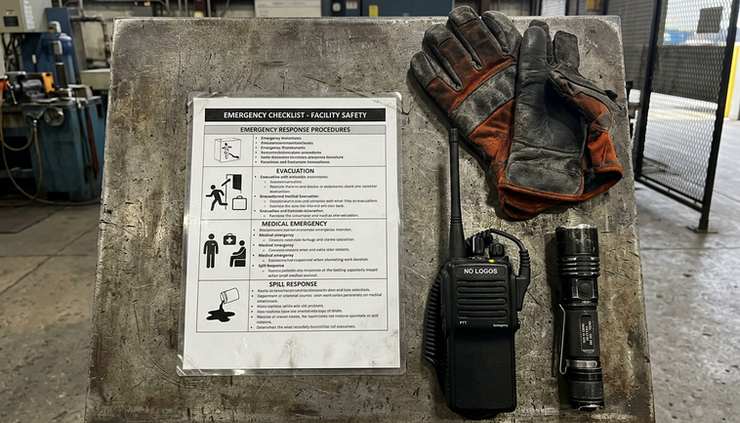
Leaders Can Measure And Reduce Startle-Related Risk
Startle risk can be managed like other operational risks. It should appear in hazard analysis, training design, incident review, and procedure testing.
The most useful question is not, “Did the worker follow the rule?” It is:
Would a skilled person under sudden stress be able to perceive the cue, understand it, remember the action, and carry it out in this environment?
That question changes the discussion. It moves the focus from blame to system performance.
Practical measures include:
Testing procedures in realistic drills before approval
Measuring time from first cue to correct classification
Tracking missed cues during exercises
Reviewing radio traffic and handovers
Auditing alarm floods and nuisance alarms
Practicing abnormal starts, stops, and transitions
Running drills across shifts, not only with the best crew
Including contractors and temporary personnel where they face exposure
Verifying that emergency equipment can be found and used in protective gear
Studying near-misses for startle, fixation, and communication breakdowns
Near-misses are especially valuable. They show where the system almost lost control. If a worker froze for three seconds but recovered, that is not a reason to criticize. It is a chance to learn what interrupted performance and what restored it.
Organizations should also watch for training drift. A drill that was difficult five years ago may become predictable. Predictable drills can create confidence without resilience.
Rotate scenarios. Change timing. Introduce realistic uncertainty. Let teams practice command transfer, conflicting indications, and partial equipment failure. Do not surprise people for entertainment. Use surprise to test the exact response the job requires.
The same principle applies to incident investigations. If a report says “loss of situational awareness,” it should explain how that loss happened. Which cues were available? Which were hidden? Which alarms competed? What did the procedure say? What did the person likely believe at the time? What made that belief reasonable?
Human error labels are too broad. They stop learning too early.
The Takeaway
Skilled workers freeze in emergencies because the brain reacts to sudden threat before it completes analysis. Startle narrows attention, disrupts working memory, weakens flexible thinking, and pushes people toward habit. Experience helps, but only when it includes the kind of rare, stressful, abnormal conditions the emergency creates.
The control measures are clear.
Train for surprise. Practice the transition from normal to abnormal. Use realistic scenarios, not only classroom review. Debrief decisions, cues, and communication. Build procedures that are short, visible, and usable under stress. Design alarms and interfaces that reduce confusion. Give teams language that lets critical information move fast.
Startle will still happen. The goal is to make recovery faster, action clearer, and poor decisions less likely when seconds matter.


